
How to actually recover your glute training
Most recovery advice is bullshit. Most of the time, you just need to chill and do nothing. Here’s why I think it’s all BS.
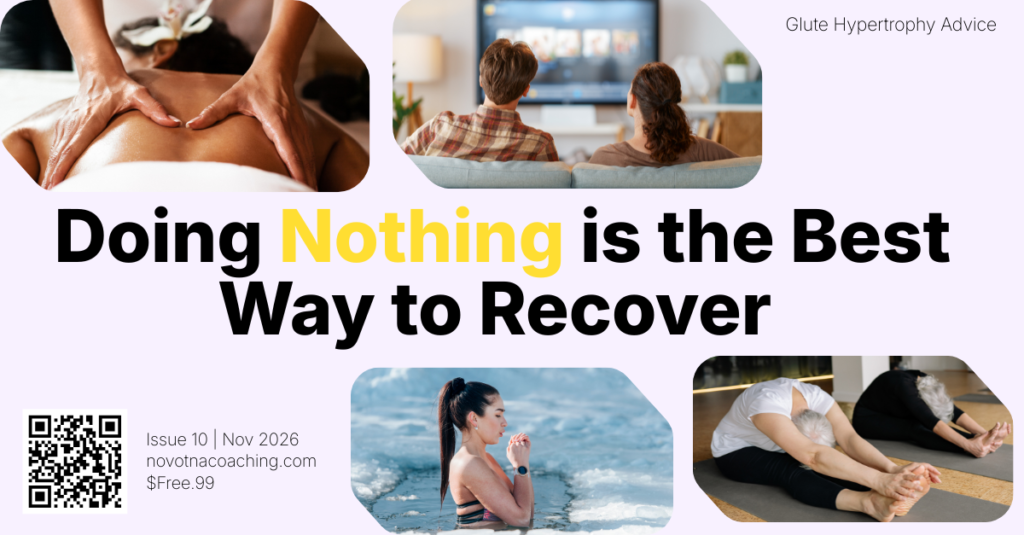
Recovery is a trending topic in the fitness world. If you follow any fitness influencer, every other post is about how to recover from training. Most recovery advice talks about contrast showers (switching from cold to hot water), ice baths, massage, red light therapy, acupuncture, etc. A lot of these modalities have their place. But I think most of them are just a waste of time. People will swear by them as revolutionary, but the majority of the time they are just trying to sell you something. Instead of focusing on this BS advice that may or may not work we should focus on the basics, the real way to recover.
I will talk about the most important things you can do to ensure you are recovering properly for the next session.
The only things that really matter so you can recover from your glute training
The only things I can confidently say that actually help with your recovery are sleep, hydration, Food, and relationships. Making sure that all these boxes are checked will set you up for being good the next session. Good recovery is really good for muscle growth.
Please get some amount of sleep
Sleep is how our body resets and an important part of the recovery process. We should be getting 6-8 hours of sleep a day if all things align. Getting some sleep is better than no sleep. The better our sleep is, the more we’ll feel refreshed the better our muscles will recover.
Be an adult and drink water
Drink water and a little bit of Gatorade or something for the extra electrolytes. You need that extra electrolyte for your body to absorb the water, or else you’ll just pee it out. Especially if you are doing cardio outside in the heat on top of your lifting. You should be drinking close to half your body weight in water.
Eat more Grow more
You need to be eating not only to recover but also to get the extra calories to help the muscle-gaining process. In order to gain muscle, you should be in a slight caloric surplus. Focus on protein and the general number of calories you are getting each day. You want to track your average calories and increase that by 100-200kcal. If you have a body fat level that you are comfortable with, then you should definitely be trying to increase your calories.
Go hang out with people you love, even if it’s yourself
Being around people you love helps with recovery. I don’t the science to back this up, but if you are feeling good, then your body feels good. Hanging out with your friends, loved ones, or even yourself will help training. A healthy mind is a healthy body.
The art of doing nothing
After training the best thing you can do is do nothing. Just sitting at home chilling for a couple of hours is the best thing for your body. Also don’t want to be doing any stressful activities such as doing your taxes or some hard work assessment. You don’t want to do any mentally or physically strenuous activities. You need to take time out for yourself. Your mind and body is connected so a relax mind is relax body.
The other stuff that may or may not help your recovery
This is the other recovery advice I mentioned earlier such as ice baths, massages, etc. Although massages have been shown to aid with fatigue and soreness, depending on what country you live in, a lot of us can’t afford getting these types of things done every week. A lot of these other modalities just make you feel good is which benefitual. But they don’t make any real changes to your muscle tissue as some of the fitness and wellness gurus suggest. They have their place in a medical rehab or sports setting helping athletes or patients feel better. But outside of that, for normal people, I don’t think it makes a big difference.
It’s better to focus on the important stuff.
Will stretching or yoga help glute recovery from the training session?
Many of us have probably heard that we need to do a cooldown in gym class or heard it from some uneducated personal trainer. This mostly involves some type of static stretching. This is where you get into some of kind of position and hold for a long duration of time. This doesn’t actually relax your muscles but adds fatigue to them. Static stretches are a form of contraction called isometric. Contractions are the movements your muscles make they require energy from your body. Static stretch recovery a large amount of energy versus relaxation. You are using the force of your body weight or resistance to elongate your muscle fibers. This causes damage and swelling to the tissue. Basically all you are doing is doing more exercise instead of relaxing.
Now, stretching has some benefits too as it increases range of motion, helping you get into a better position to target your glutes. I have been stretching the areas that need more at least 5 minutes a week per area. I think it is good for your fitness goals but not for your recovery.
Frequently Asked Questions about recovery glute training
When do I know that I am completely recovered?
First if you don’t feel any muscle soreness in the muscle that you are trying to train. Some soreness is okay but if it’s affecting your movement or making you tired, then you should wait longer. Another way to tell if you are not recovered if you start to lose strength in your lifts your reps start to drop or you need to swing the weights up instead of using good technique. I always better to rest 1 day or 2 if you are doing a heavy such doing heavy squats on top of doing 2 other glute-focused exercises.
What if I can’t get enough sleep?
If you can’t get 7-8 hours of sleep. It’s okay we’re not perfect. Not everyone can optimize their life. Personally the main thing is actually training. Training itself is the driver of the car in order to grow muscles and become a stronger person. I’m saying that sacrificing sleep for training is asking you to make yourself pass out. But as long as you’re getting some sleep in and getting your weekly training sessions then it’ll be fine.
How long does it take for glutes to recover?
It should take at least 24-72 hours to depending on how hard you trained. Sometimes it may take you a week to fully recover. The main thing is that you don’t want your recovery to affect your frequency. You need to hit your glutes twice a week. If you are not recovering on time you need to look at your sleep, nutrition, hydration etc. If you have been training for months on in then you might need to take deload week. And reset your body back off of the heavy weights.
Pay attention to your recovery so your glutes can grow
Don’t worry about the fads all these influencers are trying to push on you. Just focus on the basics that I mention in this article and you should be building the biggest glutes you can. Make sure you eat big, drink water, and sleep.